
Blue Gemstones Names Explained: Sri Lankan Varieties You Should Know
Sri Lanka has supplied the global gem trade with exceptional blue stones for over two thousand years, yet much of what circulates online today reduces this legacy to surface-level lists and oversimplified buying advice. At Pretty Facets, the goal is different. The emphasis is on origin accuracy, gemological understanding, and clarity around what truly separates Sri Lankan material from similar stones found elsewhere.
When buyers research Blue Gemstones, they are often shown generic comparisons that ignore geological origin, crystal structure, and treatment norms. Sri Lankan stones deserve deeper treatment. Their visual performance, internal characteristics, and long-term value are closely tied to how and where they formed. This guide focuses specifically on Sri Lankan varieties, not marketing labels.
Why Sri Lanka Is a Global Source for Blue Stones
Sri Lanka’s importance in the gemstone world is not accidental. The island sits on an ancient Precambrian geological foundation that has remained relatively stable for millions of years. This stability allowed gemstone crystals to grow slowly, producing cleaner internal structures and fewer stress fractures.
Most Sri Lankan deposits are alluvial, meaning stones are naturally released from their host rock and collected from gravel beds. This process preserves crystal integrity and reduces internal damage. As a result, Blue Gemstones from Sri Lanka often show higher transparency and more consistent brilliance than material mined through aggressive hard-rock extraction.
Gemological institutions such as the Gemological Institute of America have repeatedly documented the optical and structural advantages of stones formed under these conditions, particularly corundum and spinel. Regions like Ratnapura, Elahera, and Rakwana continue to produce material valued for balance rather than extreme saturation.
What Defines Blue Colour in Gemstones
Blue colour is not a single visual trait. It is the result of trace elements interacting with a gemstone’s crystal lattice at an atomic level. In Sri Lankan stones, iron and titanium play the dominant role, especially in sapphire.
A defining feature of many Sri Lankan stones is colour zoning. This refers to uneven colour distribution within the crystal, visible under magnification. Zoning is not inherently negative. Skilled cutters often orient stones to maximize face-up colour while preserving brilliance. Laboratories such as the Swiss Gemmological Institute SSEF regularly document zoning patterns when determining origin and treatment history.
Another factor often misunderstood is colour shift under different lighting. Some Blue Gemstones from Sri Lanka appear brighter in daylight and slightly violet indoors. This is a natural optical response, not a defect, and can actually indicate minimal treatment.

Ceylon Blue Sapphire
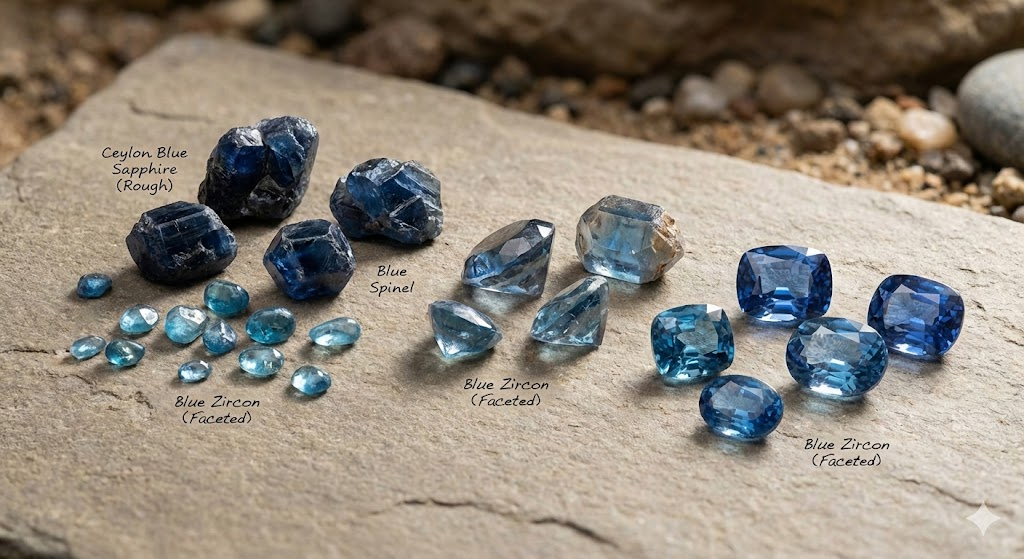
Ceylon blue sapphire occupies a unique position in the gemstone market. Unlike darker material from some regions, Sri Lankan sapphires are prized for luminosity, transparency, and clean internal structure rather than sheer depth of colour.
Colour ranges from light cornflower blue to vivid royal blue. Medium saturation stones with strong brilliance often outperform darker stones visually and commercially. Untreated material carries a significant premium, especially when supported by laboratory reports confirming both treatment status and origin.
Within the broader category of Blue Gemstones, Ceylon sapphire remains one of the most reliable choices for fine jewellery due to its durability, optical stability, and long-term market confidence.
Blue Spinel from Sri Lanka
Blue spinel is frequently overlooked or misidentified, despite its historical importance. Many stones once believed to be sapphire were later confirmed as spinel, including several famous royal gems.
Sri Lankan blue spinel typically displays a clean, slightly steely blue with excellent clarity. From a gemological standpoint, spinel is singly refractive, which affects how light travels through the stone compared to sapphire. This difference produces a distinct visual character appreciated by experienced collectors.
Among serious buyers of Blue Gemstones, spinel is valued for its natural formation, minimal treatment, and relative rarity. It performs well in jewellery and offers a compelling alternative to more commercial stones.
Blue Zircon
Blue zircon is one of the most misunderstood natural gemstones in the trade. It is often confused with cubic zirconia, despite being a completely different material with a long geological history. Sri Lanka is one of the most important sources of high-quality zircon.
Zircon has a very high refractive index, which gives it exceptional brilliance and fire. Most blue zircon undergoes heat treatment, a stable and widely accepted process that enhances colour. This treatment is fully disclosed in reputable markets.
Within the spectrum of Blue Gemstones, zircon offers striking visual performance at a lower price point, but its lower hardness requires careful setting and wear considerations.
Blue Tourmaline Varieties Found in Sri Lanka
Sri Lanka is not widely known for tourmaline in the same way it is for corundum, but select deposits do produce blue and blue green material with notable clarity. These stones are commonly referred to as indicolite, though colour saturation varies significantly.
Sri Lankan blue tourmaline typically shows softer tones compared to material from Brazil or Afghanistan. What it lacks in depth, it often makes up for in transparency and even colour distribution. For collectors focused on origin rather than intensity alone, these stones hold niche appeal within the wider category of Blue Gemstones.
Tourmaline’s lower hardness compared to sapphire means setting choice matters. Protective designs and occasional wear are more suitable than daily exposure.
Blue Topaz from Sri Lanka
Blue topaz is present in Sri Lanka, though it differs from how the gemstone is commonly marketed internationally. Natural topaz from Sri Lankan soil typically forms as colourless or pale material. The vivid blue shades seen in the market are usually achieved through treatment, a practice that is widely accepted but must be disclosed.
Sri Lankan topaz is valued for its clarity and crystal size rather than colour depth. Its structure allows for clean cutting and strong brilliance, making it suitable for statement jewellery pieces. Within the broader discussion of Blue Gemstones, topaz occupies an accessible price category and appeals to buyers prioritising size and clarity over rarity.
Due to its lower hardness compared to sapphire and spinel, blue topaz is best suited for earrings, pendants, and occasional wear rings rather than daily exposure.
Blue Aquamarine Found in Sri Lanka
Aquamarine is another blue gemstone that occurs naturally in Sri Lanka, though it is less abundant than sapphire or spinel. Sri Lankan aquamarine is typically lighter in tone, showing soft blue to blue green hues with excellent transparency.
The appeal of Sri Lankan aquamarine lies in its clarity and calm colour rather than saturation. Stones are often minimally treated, if at all, and are appreciated for their clean internal appearance. Among collectors of Blue Gemstones, aquamarine is often chosen for its understated elegance and natural formation.
Aquamarine performs well in jewellery when set thoughtfully. While durable enough for regular wear, protective settings are recommended to minimise edge wear over time.
Blue Gemstones Names Explained (Sri Lankan Varieties)
| Gemstone Name | Typical Blue Tone | Hardness (Mohs) | Common Treatment | Key Visual Trait | Sri Lankan Value Insight |
| Ceylon Blue Sapphire | Cornflower to royal blue | 9 | Often untreated | Bright, lively brilliance | Strong long-term value and demand |
| Blue Spinel | Steely to vivid blue | 8 | Rarely treated | Clean clarity, sharp light return | Undervalued compared to sapphire |
| Blue Zircon | Electric to sky blue | 6.5–7.5 | Heat treated | High fire and sparkle | High visual impact at lower cost |
| Blue Tourmaline (Indicolite) | Soft blue to blue green | 7–7.5 | Usually untreated | Even colour transparency | Niche appeal for collectors |
| Blue Topaz | Light to vivid blue | 8 | Commonly treated | Large clean crystals | Affordable with strong visual presence |
| Blue Aquamarine | Pale blue to blue green | 7.5–8 | Minimal or none | Calm colour and high clarity | Elegant, collector-friendly appeal |
How to Identify Natural Blue Stones from Sri Lanka
Correct identification begins long before laboratory testing. Visual inspection, internal features, and optical behaviour offer valuable clues. Sri Lankan stones often display cleaner internal structures due to alluvial formation, though inclusions are still present and expected in natural material.
Refractive behaviour is a key differentiator. Sapphire and zircon are doubly refractive, while spinel is singly refractive. Understanding this distinction helps separate visually similar stones. Buyers researching Blue Gemstones should also pay attention to colour zoning patterns, which can be diagnostic of certain origins.
Laboratory certification becomes essential when origin claims influence price. Reputable reports confirm whether a stone is natural, treated, and consistent with Sri Lankan formation characteristics.
Value Factors That Affect Sri Lankan Blue Stones
Value is never determined by colour alone. Origin, treatment status, clarity, cut quality, and market demand all interact to establish price. Sri Lankan origin carries weight, particularly for sapphire, but it does not automatically guarantee higher value.
Untreated stones consistently outperform treated equivalents in long-term pricing. Market data shows that buyers increasingly prioritise disclosure and documentation. Within the category of Blue Gemstones, transparency has become a value driver in its own right.
Rarity also plays a role. While sapphire is widely recognised, fine blue spinel and zircon from Sri Lanka remain underrepresented in mainstream retail, creating opportunities for educated buyers.
Choosing the Right Blue Stone for Jewellery
Selecting a gemstone for jewellery requires balancing aesthetics with durability. Sapphire remains the most versatile option for daily wear, followed closely by spinel. Zircon and tourmaline require more considered use due to lower hardness.
Design choices should account for edge protection, setting depth, and exposure risk. Buyers comparing Blue Gemstones for rings, pendants, or earrings should evaluate lifestyle factors as carefully as colour preference.
For those exploring rarer colour variations, Sri Lanka also produces unique stones such as Padparadscha sapphire. You can explore this variety in detail through the Padparadscha sapphire guide, which explains its colour balance and valuation nuances.

Ethical Sourcing and Transparency in Sri Lanka
Sri Lanka’s gemstone sector is heavily regulated compared to many producing countries. Licensing, export controls, and disclosure requirements help maintain buyer confidence. Small-scale mining remains the norm, supporting local communities while preserving traditional methods.
At Pretty Facets, ethical sourcing and origin transparency are central principles. Buyers who want to move from education to acquisition can explore curated offerings through the shop, where sourcing standards and documentation are clearly outlined.
Responsible sourcing has become inseparable from value. Among serious collectors of Blue Gemstones, ethical provenance is no longer optional.
FAQs About Sri Lankan Blue Stones
Which Sri Lankan blue stone is best for engagement rings
Sapphire is the most durable and widely trusted choice, though spinel is also suitable for daily wear when properly set.
Are all Sri Lankan sapphires untreated
No. While Sri Lanka is known for untreated material, treatment still exists and should always be disclosed.
How can buyers verify Sri Lankan origin
Laboratory reports from recognised institutions remain the most reliable method, especially when pricing reflects origin claims.
When researching Blue Gemstones, asking the right verification questions is often more important than focusing on colour alone.




One comment on “Blue Gemstones Explained: Sri Lankan Varieties Guide Expert”