
Lighting Matters | How to Check and Grade Gemstone Color Correctly
Gemstone color is often treated as something obvious. A stone looks blue, red, or green, and the judgment seems complete. In reality, gemstone color is one of the most complex visual properties to evaluate, and lighting plays a decisive role in how that color is perceived, described, and graded.
At Pretty Facets, gemstone color is approached as a measurable and observable characteristic, not a subjective impression. Color does not exist in isolation. It is revealed by light, shaped by crystal structure, and interpreted by the human eye. Understanding how lighting alters gemstone color is essential for accurate evaluation, whether you are studying gemstones, buying them, or simply trying to understand why the same stone looks different in different environments.
This guide explains how gemstone color works, why lighting matters so much, and how to assess color correctly using principles followed in gemology rather than marketing or visual shortcuts.
Understanding What Gemstone Color Really Means
Gemstone color is not a fixed surface trait. It is the result of how a gemstone interacts with light. When light enters a gemstone, certain wavelengths are absorbed while others are transmitted or reflected back to the eye. The combination of those remaining wavelengths is what we perceive as gemstone color.
This is why gemstone color cannot be judged accurately without considering lighting conditions. Change the light source, and the balance of wavelengths changes. The stone itself remains the same, but the observed color does not.
Another important distinction is between inherent color and perceived color. Inherent color is controlled by the gemstone’s chemistry and crystal structure. Perceived color is what the observer sees under a specific lighting environment. Most confusion around gemstone color comes from failing to separate these two ideas.
Human vision also plays a role. The eye adapts quickly to lighting conditions and surrounding colors. A gemstone viewed against a dark background or under warm indoor light can appear richer than it truly is. This does not mean the color has improved. It means perception has shifted.
The Three Technical Components of Gemstone Color
In gemology, gemstone color is evaluated using three interconnected components: hue, tone, and saturation. All three must be considered together. Ignoring even one leads to incomplete or inaccurate color assessment.
Hue: The Actual Color Family
Hue refers to the basic color family of a gemstone, such as blue, red, green, or yellow. Many gemstones also show secondary hues. For example, a blue stone may carry a violet or green modifier.
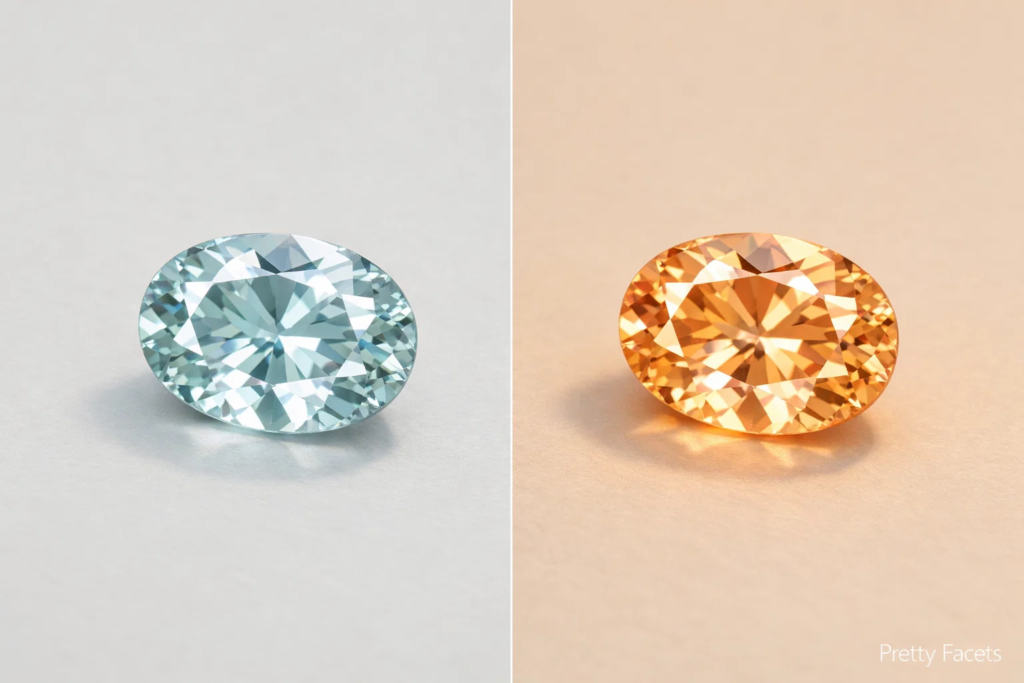
Lighting strongly affects how these secondary hues appear. Cooler light sources tend to emphasize blue and violet components, while warmer light can push colors toward yellow or red. Under certain lighting, a secondary hue may become more visible, changing how the gemstone color is described.
Accurate hue evaluation requires lighting that does not exaggerate or suppress parts of the visible spectrum. This is why uncontrolled indoor lighting often leads to incorrect hue descriptions.
Tone: Lightness and Darkness of Gemstone Color
Tone describes how light or dark the gemstone color appears. It ranges from very light to very dark. A gemstone with ideal hue can still be less desirable if the tone is too dark or too pale.
Lighting intensity directly influences perceived tone. Strong lighting can make a gemstone appear lighter, while dim lighting can push the same stone into an overly dark appearance. This effect is especially noticeable in gemstones that already sit near the darker end of the tone scale.
When tone is misjudged, saturation is often misjudged as well. A stone may appear richly colored simply because it is dark, not because the color itself is strong.
Saturation: Strength and Purity of Color
Saturation refers to the intensity or purity of the gemstone color. Highly saturated colors appear vivid and strong, while low saturation results in grayish or brownish tones.
Artificial lighting, especially spotlight-style lighting, can falsely increase the appearance of saturation. This happens because strong directional light enhances contrast and brilliance, which the eye can mistake for color strength.
True saturation should be evaluated under lighting that reveals color evenly rather than dramatically.
Why Lighting Has Such a Strong Effect on Gemstone Color
Light is not uniform. Different light sources emit different combinations of wavelengths. A gemstone does not reflect all wavelengths equally, so its appearance depends heavily on the spectral balance of the light illuminating it.
In addition, gemstone cut and transparency amplify lighting effects. Faceted stones bend and return light in complex ways. Bright reflections and flashes can distract the eye, making it harder to judge the underlying gemstone color accurately.
This is why color of gemstone assessment is not done under random lighting conditions in professional settings. Controlled lighting is used to reduce visual noise and isolate color as much as possible.
Natural Light and Gemstone Color Evaluation
Why Indirect Daylight Is the Standard
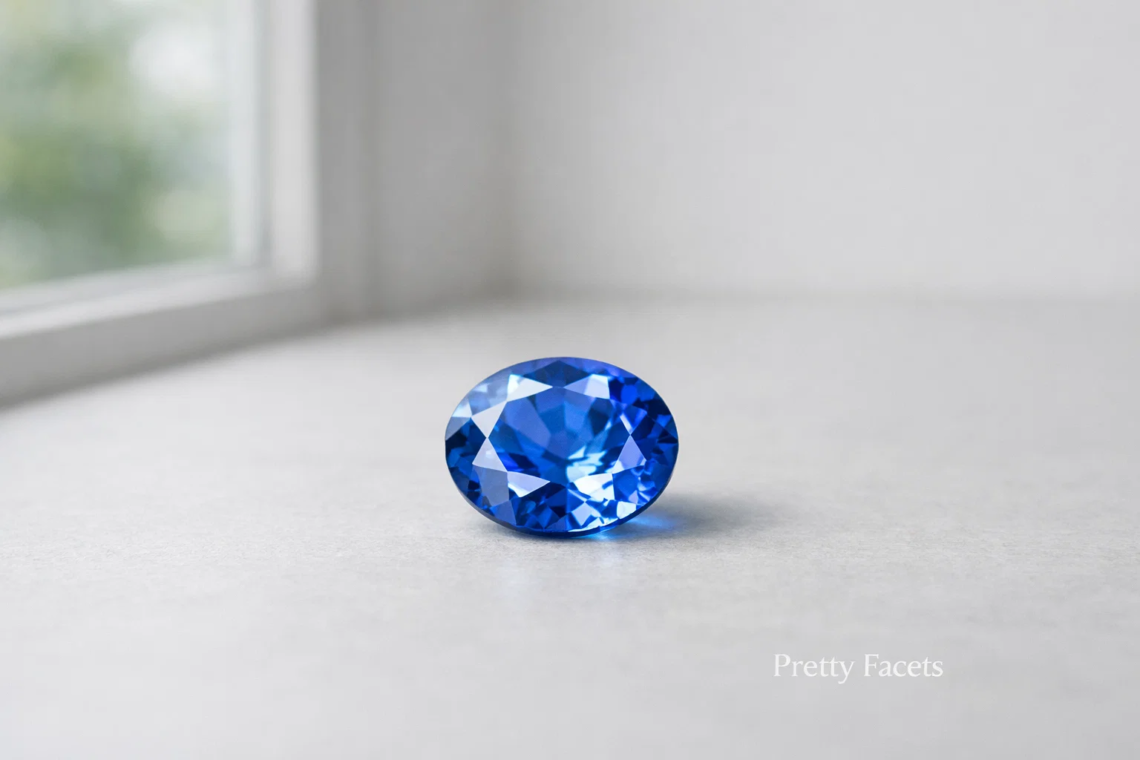
Indirect natural daylight is considered the reference lighting condition for evaluating gemstone color. It provides a balanced spectrum without the strong color bias found in many artificial light sources.
Direct sunlight, however, is not ideal. It is too intense and creates glare, which can wash out color or exaggerate brilliance. Indirect daylight, such as light from a window without direct sun exposure, allows gemstone color to be seen more evenly.
Midday daylight is generally more consistent than early morning or late afternoon light, which can shift warmer or cooler depending on atmospheric conditions.
Common Daylight Mistakes
Even natural light can mislead if conditions are not controlled. Window glass can filter or distort light. Reflected colors from walls, clothing, or nearby objects can influence perception. Cloud cover can change color temperature within minutes.
For these reasons, color of gemstone should never be judged casually, even in daylight. Awareness of the environment is essential.
Artificial Lighting and Its Impact on Gemstone Color
Most gemstone viewing occurs under artificial lighting, especially in retail and indoor settings. Understanding how different light sources affect gemstone color helps explain why stones often look different once they leave a showroom.
LED lighting varies widely in quality. Cool LEDs tend to intensify blue tones and suppress warmth, while warm LEDs enhance reds and yellows. Fluorescent lighting can introduce greenish casts and flatten color depth. Incandescent and halogen lighting create a warm glow that often makes gemstone color appear richer than it truly is.
These effects are not accidental. They are predictable outcomes of how gemstones interact with different light spectra.
Proper Setup for Checking Color Accurately
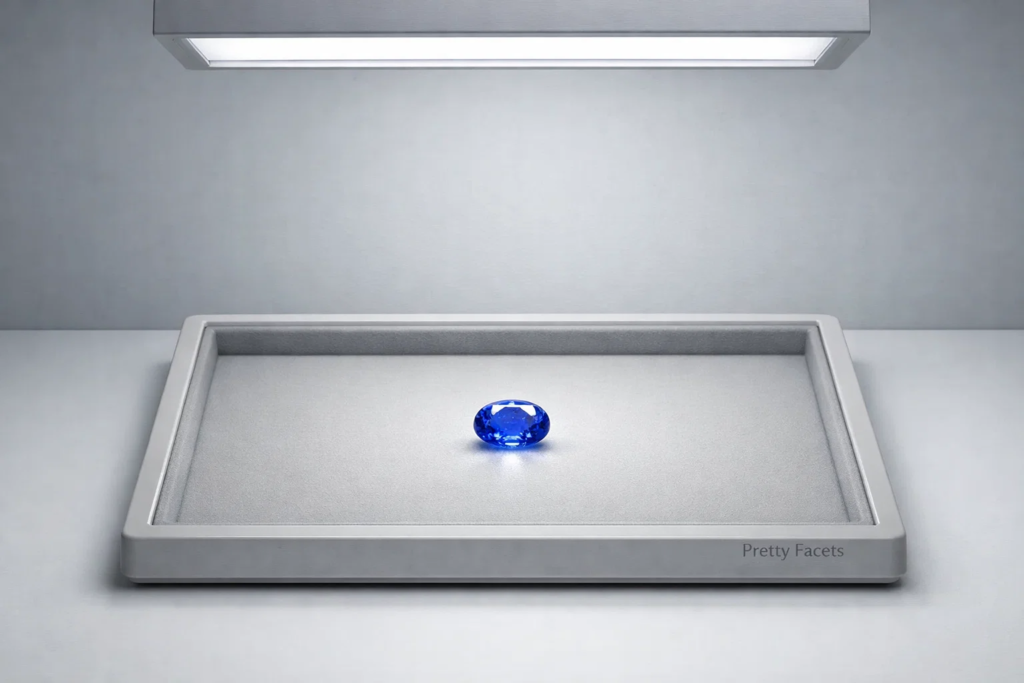
Accurate evaluation starts with controlling the environment. Small visual distractions can influence perception more than most people realize, which is why professional assessment avoids casual or decorative settings.
Key elements of a reliable setup include:
- Consistent, neutral lighting in the daylight range, positioned to avoid glare
- Neutral backgrounds such as grey or white to prevent color contamination
- Clean gemstones, free from oil, dust, or residue that can dull or distort appearance
When these conditions are met, gemstone color is revealed more honestly, without artificial enhancement from surroundings or light bias.
Step-by-Step Method to Evaluate Color Correctly
Begin by observing the stone face-up, as this reflects how it will appear when worn or displayed. Take note of the overall impression without focusing on sparkle or reflections.
Next, tilt the gemstone slowly. Observe how the color behaves as angles change. Look for consistency rather than peak moments of visual impact.
Pay special attention to zoning or uneven distribution. Rotating the stone helps reveal areas that appear darker, lighter, or slightly different in hue. Finally, compare the stone under a second lighting condition to understand how stable the appearance remains rather than which setting makes it look best.
This process prioritizes observation over assumption and separates inherent qualities from lighting-driven effects.
Common Errors in Color Judgment
Many misunderstandings come from predictable mistakes, especially outside controlled environments.
Common issues include:
- Mistaking brightness or brilliance for strong color
- Judging only the face-up view and ignoring angled observations
- Relying on photographs, which often misrepresent color due to camera processing
- Evaluating under a single light source and assuming the appearance is fixed
These errors explain why stones often look different once removed from showrooms or display lighting.
How Professionals Grade Color in Practice
Professional grading relies on controlled conditions, experience, and comparison rather than absolute measurements. Color is described using standardized terminology based on how the stone behaves under known lighting.
Reference stones are often used to place a gem within a relative range. This acknowledges a key reality: gemstone color grading is descriptive, not mathematical. Even under ideal conditions, subtle variation exists.
At Pretty Facets, this approach reflects the broader philosophy outlined on the About Pretty Facets page, where transparency and accuracy take priority over simplified labels or visual exaggeration.
Color and Long-Term Value Considerations
Market demand often favours specific appearances, but preference does not always align with stability. Stones that rely on narrow lighting conditions to appear attractive may lose appeal over time.
Consistency across environments is often a stronger indicator of lasting value than peak appearance under ideal conditions. Understanding gemstone color as a behaviour rather than a static trait leads to more informed and durable decisions.
Sri Lankan blue stones offer a clear example of this principle in practice. Their appearance under different lighting conditions is explored in depth in the guide on Sri Lankan blue gemstone varieties, which illustrates how origin, structure, and light interact.
Final Perspective
Learning to assess color accurately requires patience and restraint. When lighting is controlled and observation is systematic, gemstone color becomes predictable rather than subjective.
Pretty Facets is built around this principle, curating material selected with clarity and consistency in mind. Readers who wish to explore stones chosen under these standards can do so through the Pretty Facets shop, where selection emphasizes behaviour over first impression.
By approaching gemstone color with structure instead of assumption, evaluation becomes confident, repeatable, and grounded in reality rather than visual persuasion.
Faqs
Why does the color of gemstones look different in various lighting?
Gemstones interact differently with each light source. Changes in light spectrum alter which wavelengths are reflected, causing visible shifts in color appearance.
What lighting is best for checking gemstones color accurately?
Indirect natural daylight is preferred because it provides balanced illumination without exaggerating or muting specific color tones.
Can artificial lighting improve gemstone color?
Artificial lighting can enhance appearance temporarily, but it may distort true color by emphasizing certain hues or increasing perceived saturation.
Is gemstone color grading an exact measurement?
No. Color grading is descriptive rather than absolute, based on controlled observation and comparison under standardized conditions.



One comment on “Lighting Matters: Guide to Check and Grade Gemstone Color”